
Today was “finance day” at COP and with the link between climate and military funding we wore white to demand peace (I don’t think many people noticed the massive brown mark on my pale dress caused by a big spillage of coffee at breakfast, an act committed too late to change before boarding the bus…).
Trillions are needed to facilitate the green transition in low and middle income countries; more details on this later, but this was also the day that protests began at COP 29 (they aren’t allowed while the VIPs are around).
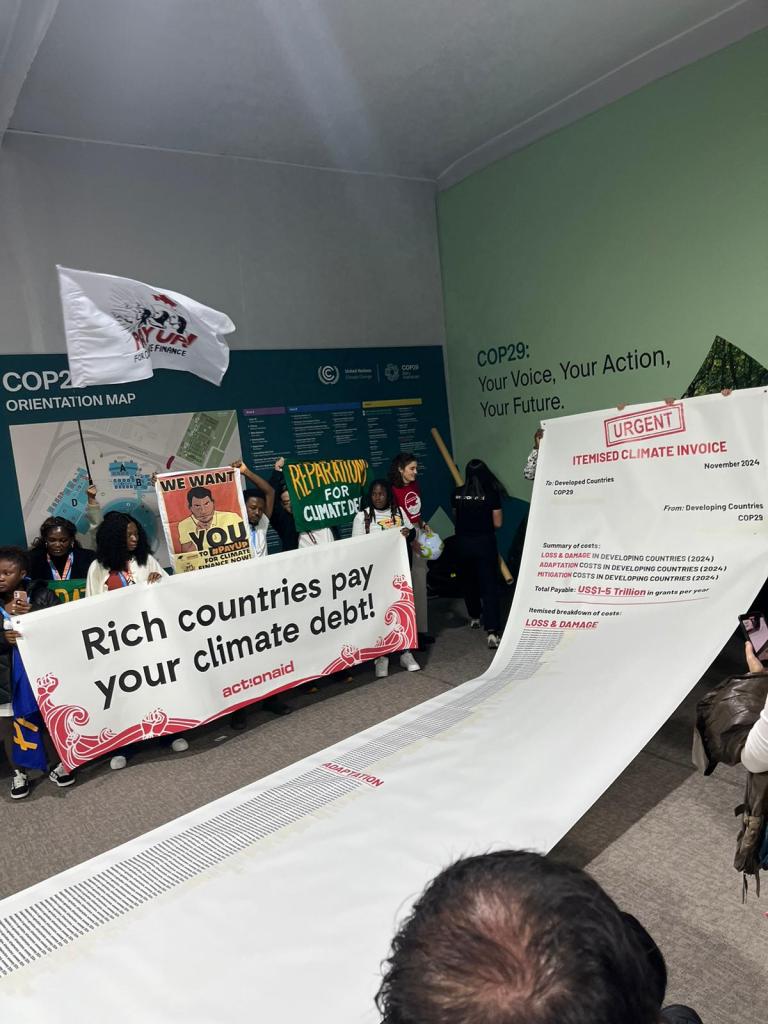
The first protest on entry to the venue today had a giant bill to show what we owe:
We had a consultation then at our TUNGO delegation meeting by the Chair of the IPCC (who was previously chair of Just Transtion Scotland). Just transition issues were covered in the last IPCC report and he gave examples of common issues, for example, “temporal dislocation”; ie where there is a gap of time or place between old jobs being lost and new ones coming on board; this resonates with us in the UK as we had that very gap between the Port Talbot blast furnace steelworks closing and the new electric arc furnace opening up (a gap of at least three years so actually no use to the thousands that were made redundant).
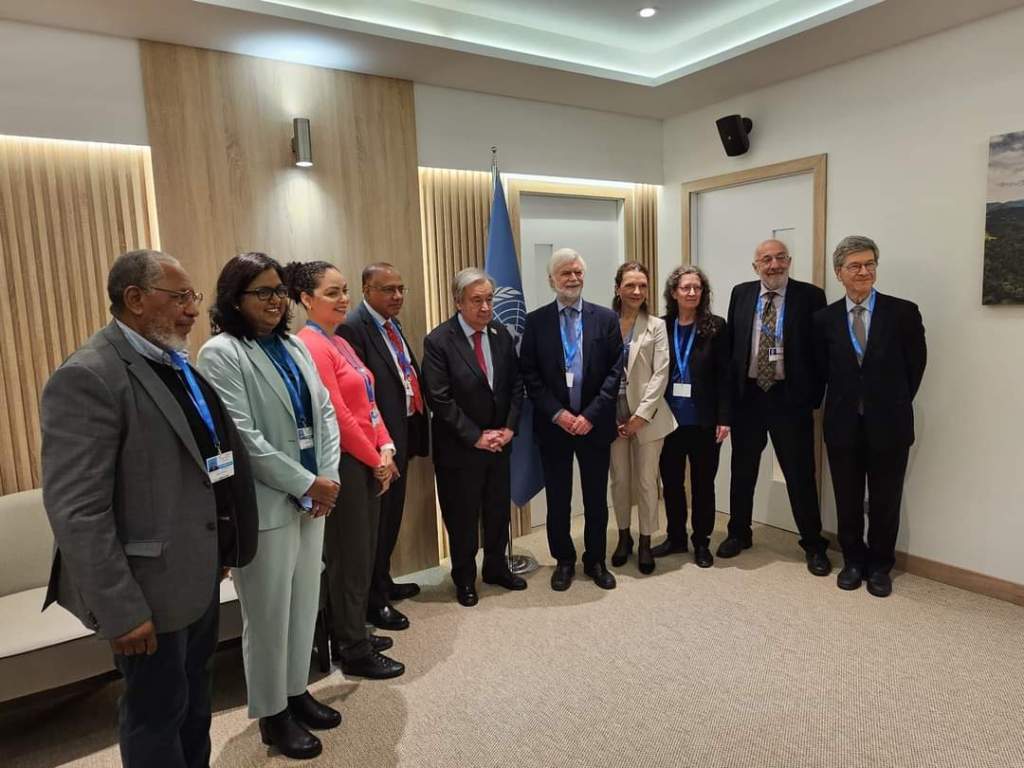
The chair also raised the issue of industry trying to make money out of “green training ” where sometimes the training is not that useful or relevant. So these are the reasons a just transition does need to be embedded. We were asked for our views on how the IPCC could engage with us. I requested accessible summaries of the reports for teachers and students and it was explained that the IPCC only collate the work of scientists so it is not in their gift to summarise that work, however, I was pointed to the website and social media of the IPCC where it is possible to follow regular updates. Here they are at COP today, with the Scottish Chair 5th from the right, next to the Secretary General of the UN, who supports our calls on Just Transition; TUNGO reps and others met with him today:
Union reps then shared updates from yesterday (because we are all following separate meetings and activities- there is so much!).
Yesterday Argentina LEFT the COP thanks to their far-right leader aligning himself with Trump. Lucky for us, the Argentinian reps, who had thought they might be forced to fly home, were given new passes by the Chile delegation!!
Meanwhile France and Azerbaijan are apparently playing tit for tat because of their disagreements over Armenia and the former disputed territories of this host country that have large Armenian populations.
Other negotiations are lacking in the amount of finance being put forward, as per usual. Billions rather than trillions…
Reps, in our many whatsapp groups, shared draft texts for the various strands of the negotiations, added in suggested wording around workers and jobs, where this was missing, then sat in corners on laptops emailing our delegation teams to ask them to accept our changes. This is interesting because for 15 years we had no one to send these to in the UK; but now we do.
In one meeting today, our minister for climate, Kerry McCarthy MP, was heard saying ” we’re halfway through a decisive decade…we can’t afford to be complacent, we need to go further; there is a gap between where we are and where we need to be; the UK remains committed as the new UK government to keeping 1.5 alive”. Encouraging words…
After a spell of timetabling my day over coffee- which was an exercise not dissimilar to those sudoku puzzles marked “more difficult”- and a quick sending out of the ITF campaign link calling for sustainable transport (hopefully some readers have seen this: ITF Global Poll: People demand investment in sustainable transport. Will leaders at COP29 in Baku finally deliver? | ITF Global ), I then took myself along to the joint USA/ Brazil meeting on heat stress, where we heard from union reps working in Brazil and elsewhere. One story from Bangladesh told of a boss locking the door to the stair well which led to 100 workers dying in a fire. Like UK unions, many from the audience were engaged in heat stress work themselves- we heard from Nigeria and Sub-Saharan Africa and in fact, after the meeting, agreed we should collaborate more on this campaign.
The Solidarity Centre in Washington DC presented a report showing that where workplaces are union organised, and bargaining is carried out collectively, 74% less time is spent by workers in dangerous temperatures.
Barbara, from the EU, urged consumers to also play a role in questioning the working conditions behind the garments and products we buy.
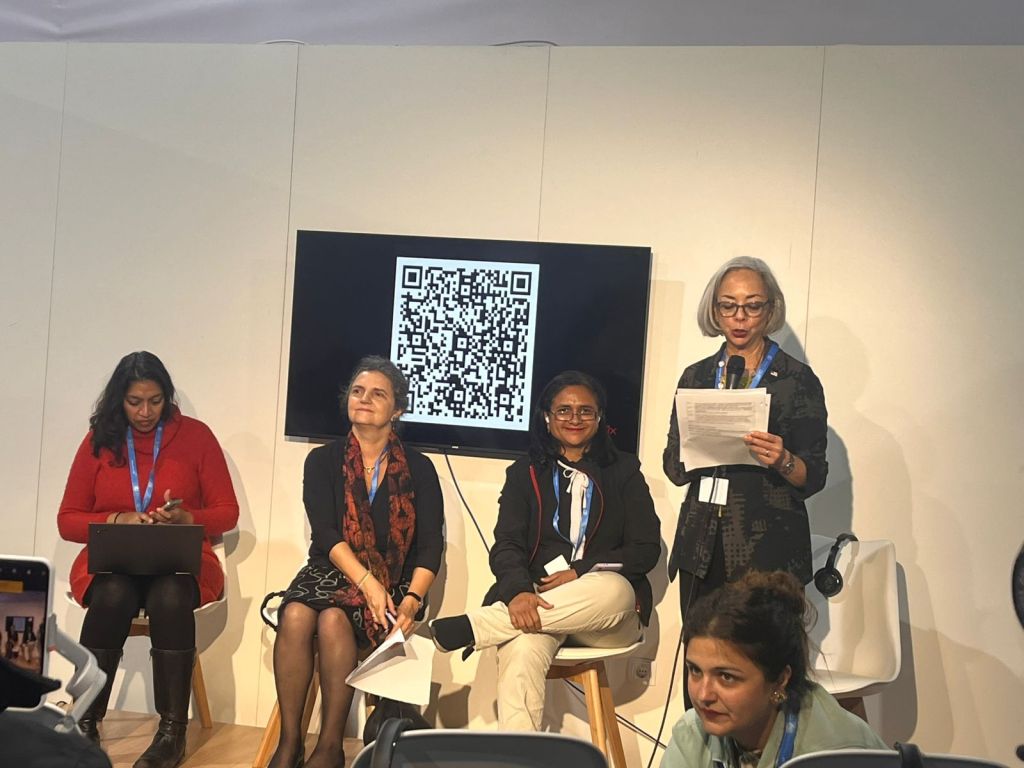
Sadly the QR code system for receiving translation from Portugese direct to your phone was not working for everyone present; perhaps an example of where it’s better to use people than AI; a just transition needed here too…
Over lunch, I caught up with my fellow teacher rep Colin from Canada. We discussed climate education, the strangeness of COP and the campaigns of Education International, who are lobbying to try and get him to speak at a high level ministerial meeting next week where currently there is no union voice.
Together we attended the Youth-led Climate Forum meeting on links between health and education.

This was introduced by an eloquent Azeri teenager whose brother, he said, has autism, and can be highly troubled by extreme and sudden weather events. This was a trend in the meeting as young people expressed what they saw as the links between poor mental health and climate change and how they would love to see more effort to bring the two together for the sake of children and young people.
Another speaker talked about his severe asthma made worse by pollution and how students were dropping out of school. Those of the youth constituency who were observing negotiations explained that, once again, climate finance- or lack of- is the road block.
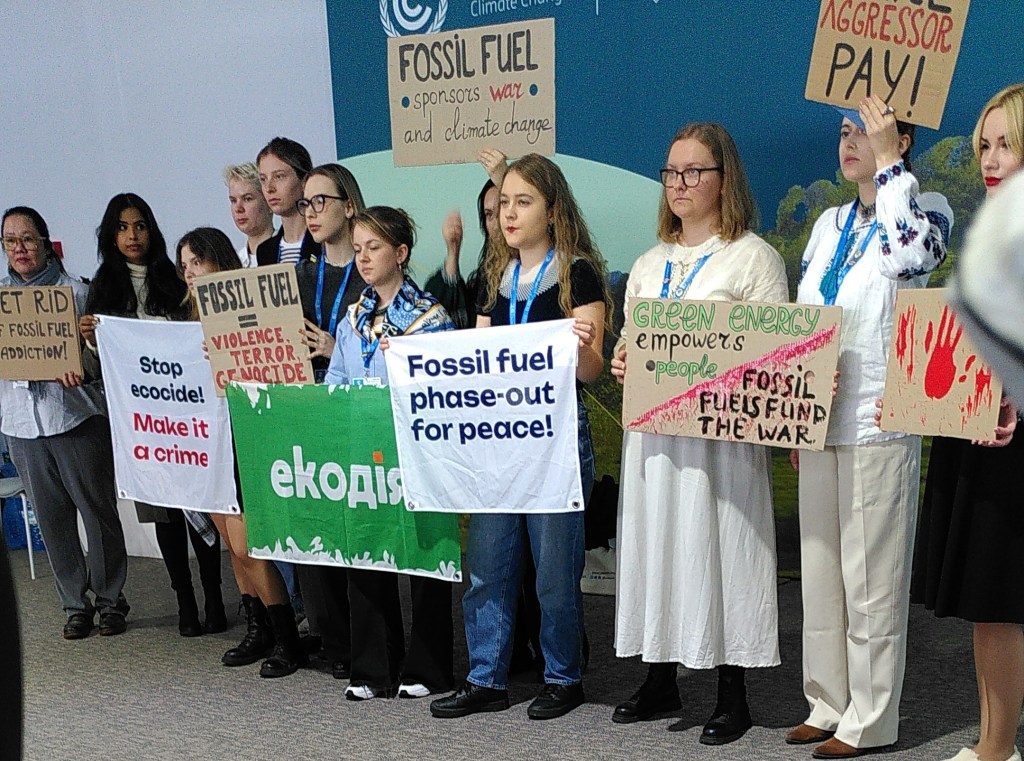
And just so I wouldn’t forget, this lot greeted me on route to my next meeting:
To continue the theme, Tony and I then joined the fossil fuel non-proliferation treaty meeting, focussed this time on banking. This was held in the “cryosphere pavilion” and introduced by a PhD researcher based at St Andrews University, studying mountain glaciers (particularly the Tian Shan mountains in Kazahstan), Ella Wood.

The glacial lakes here have historically provided water to millions as they very slowly melt. The melting is, as we know, speeding up at an alarming rate. Before long, a threshold will be reached that will mean the “peak” period will be passed and after that water supply will begin to slow and finally use up. It appears that in the area studied by Ella, this peak has already been reached; in other areas this is only decades away. The melting is also projected to destroy villages (and lives as a result) and speed up other consequences such as sea level rise and increase in emissions of carbon and methane that were formerly locked up in the ice.
Avinash Persaud, climate adviser to the inter-American Bank, came straight to the point: 2.4 trillion a year is needed to facilitate developing countries to transition away from fossil fuels. And because of the lack of transitioning away so far, 3.1 billion is needed for adaptation to the changes that result. And also- 100 million for loss and damage to the countries suffering the consequences of what the others have caused. He said this needs to be TODAY as there is NO TIME TO WAIT.

Martin Rohner, CEO of the Global Alliance for Banking on Values ( a sort of coalition of ethical banks like Triodos and Unity Trust) informed us that his coalition has signed up to the fossil fuel treaty because we need finance to change as a way of changing finance! His banks find that investing in renewables and divesting from extraction guards against volatility as well as being the moral thing to do. It is hoped that this puts pressure on the others, and he does feel hope as he sees this influence happening.
Amiera Sawas, the research lead for the treaty, assured us the finance IS there. Military spending has increased year on year, which in itself contributes hugely to extraction and emissions.
Avinash’s last words were “governments are being elected to deport migrants not to fund them” and that we need everyone to lobby their governments to demand change.
The fossil fuel non-proliferation treaty is, in my view, the best initiative I have seen to come out of COP in my three years of involvement. The NEU and UNISON recently helped facilitate a UK speaking tour of the organisation, to encourage people, unions and councils to sign up. Please do so now if you haven’t already; talks OFTEN let us down; collective action has been shown, throughout history, to work:
The Fossil Fuel Non-Proliferation Treaty Initiative
Come on everyone! We need trillions not billions! Do it for nature if you don’t do it for me.


 faircop
Leave a comment